Services
IALE Journal "Landscape Ecology"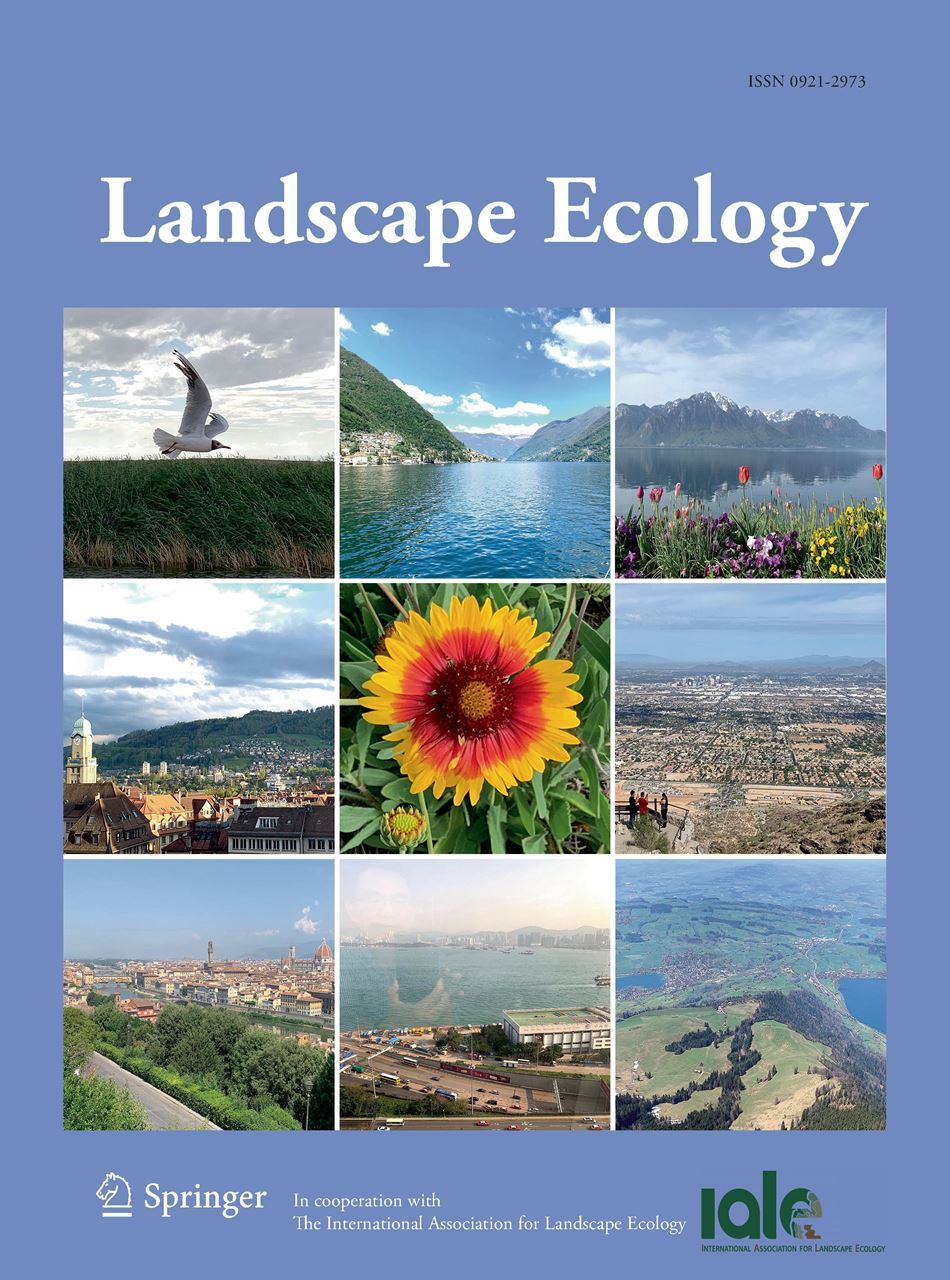
IALE works in close collaboration with Springer to produce the major journal in the field, Landscape Ecology. First published in 1987, Landscape Ecology has become the flagship journal in the fields of landscape ecology and sustainability science of landscapes. Landscape Ecology publishes theoretical, methodological, and empirical studies that help better understand and improve the ecology and sustainability of landscapes. The journal welcomes manuscripts that focus on:
Landscape Ecology publishes several types of papers such as Research Articles, Perspectives, Reviews, and Short Communications. As timely assessments of key topics in landscape ecology are critically important for advancing the theory and practice of the field, the journal encourages the submission of reviews and perspective articles that synthesize existing knowledge and ideas, critique existing perspectives and approaches, and explore new research frontiers. We also offer incentives to students and Early Career Researchers when their Perspectives or Reviews paper is accepted for publication. In addition, Short Communications are designed for rapid publications of novel research results as well as new methods and techniques. Landscape Ecology is the key barometer of how the field is progressing and, therefore, accepts the best papers that represent your science and your profession. Learn more about the Landscape Ecology journal and submit your paper today!
Feel free to contact Editor-in-Chief Dr. Jianguo (Jingle) Wu (Jingle.Wu@asu.edu) or Springer Editor Takeesha Moerland-Torpey (takeesha.moerland-torpey@springer.com) for more information about Landscape Ecology! We are proud to offer IALE Members the following benefits from Springer:
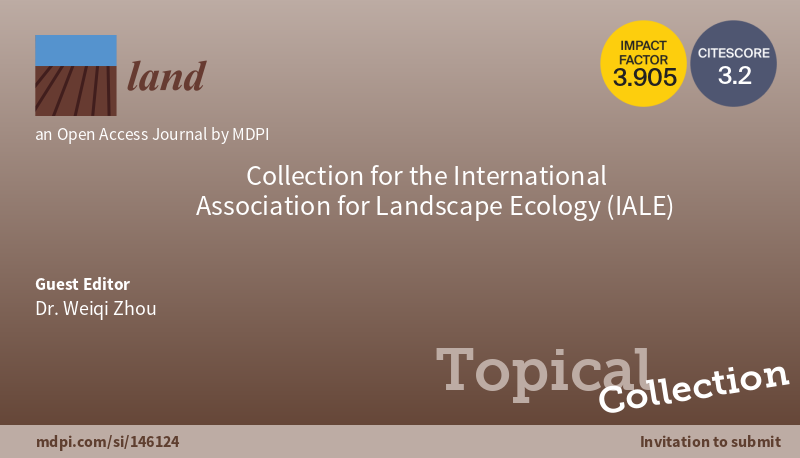
Land Land (ISSN 2073-445X) is an international and cross-disciplinary, peer-reviewed, open access journal of land system science, landscape, soil–sediment–water systems, urban study, land–climate interactions, water–energy–land–food (WELF) nexus, biodiversity research and health nexus, land modelling and data processing, ecosystem services, and multifunctionality and sustainability etc., published monthly online by MDPI. Land (ISSN 2073-445X) is an international and cross-disciplinary, peer-reviewed, open access journal of land system science, landscape, soil–sediment–water systems, urban study, land–climate interactions, water–energy–land–food (WELF) nexus, biodiversity research and health nexus, land modelling and data processing, ecosystem services, and multifunctionality and sustainability etc., published monthly online by MDPI.
Since 2017, IALE has been affiliated with Land. A new Collection has been created to collate all submissions from IALE members. The topics could cover, but are not limited to:
As part of this collaboration, all members of the IALE will receive a 10% discount on the article processing charge (APC) when submitting articles to Land. Please choose IALE as your instituation when submitting papers to this Collection. According to the Journal Citation Reports/®/ in June 2022, the Impact Factor of Land is 3.905.
Landscape Online is a peer-reviewed, open-access e-online journal supported by theInternational Association for Landscape Ecology (IALE) and its community, published by IALE-D. The focus lies on contributions on landscape research with inter- or transdisciplinary aspiration. Landscape Online is indexed by many literature search databases and since 2012 listed in the Scopus, the largest citation and abstract data base for scientific publications. Landscape Online offers to publish ‘research articles’, ‘short papers’, and ‘reviews’. Furthermore, it offers the article category ‘ideas’ to present new concepts, methods, methodologies, models, approaches, or theoretical aspects in landscape ecology that should be further discussed within the scientific community, and ‘syntheses’ for more specifically target scientific outputs for knowledge brokerage, putting emphasis on theory-practice transfer and policy making. Furthermore, Landscape Online offers 'Living Special Issues', enabling ongoing publications of specific thematic orientations as collected editions. Journals with reduced subscription for IALE members
Solutions is an online and print journal, a hybrid between a popular magazine and a peer-reviewed journal. It is intended for a broad audience that reaches beyond traditional academic journals to the informed public. It will provide a much-needed forum, devoted to whole-system solutions and the design of an integrated human and natural world. Solutions encourages and publishes integrative solutions to the world’s most pressing problems. Solutions offers reduced subscription (-5 US$) for IALE members. Book SeriesCambridge Studies in Landscape EcologyCambridge Studies in Landscape Ecology presents synthetic and comprehensive examinations of topics that reflect the breadth of the discipline of landscape ecology. The focus is on spatial relationships at a variety of scales, in both natural and highly modified landscapes, on the factors that create landscape patterns; and on the influences of landscape structure on the functioning of ecological systems and their management. Some books in the series develop theoretical or methodological approaches to studying landscapes, while others deal more directly with the effects of landscape spatial patterns on population dynamics, community structure, or ecosystem processes. Still others examine the interplay between landscapes and human societies and cultures. The series is published in collaboration with the International Association for Landscape Ecology (IALE), which has Chapters in over 50 countries. IALE aims to develop landscape ecology as the scientific basis for the analysis, planning, and management of landscapes throughout the world. The organization advances international cooperation and interdisciplinary synthesis through scientific, scholarly, educational, and communication activities. Springer Landscape SeriesSpringer’s innovative Landscape Series is committed to publishing high-quality manuscripts that approach the concept of landscape from a broad range of perspectives. Encouraging contributions on theory development, as well as more applied studies, the series attracts outstanding research from the natural and social sciences, and from the humanities and the arts. It also provides a leading forum for publications from interdisciplinary and transdisciplinary teams.Drawing on, and synthesising, this integrative approach the Springer Landscape Series aims to add new and innovative insights into the multidimensional nature of landscapes. Landscapes provide homes and livelihoods to diverse peoples; they house historic—and prehistoric—artefacts; and they comprise complex physical, chemical and biological systems. They are also shaped and governed by human societies who base their existence on the use of the natural resources; people enjoy the aesthetic qualities and recreational facilities of landscapes, and people design new landscapes.As interested in identifying best practice as it is in progressing landscape theory, the Landscape Series particularly welcomes problem-solving approaches and contributions to landscape management and planning. The ultimate goal is to facilitate both the application of landscape research to practice, and the feedback from practice into research. | News
Bulletin |